Most robotic automation companies will tell you what their systems can do. FMIBI Automation can prove it — on its own factory floor.
Facing rising demand for a product that was slow, skill-dependent and difficult to make by hand, FMIBI Automation turned its robots on its own window stay production. The result: roughly double the throughput, a job that once took six skilled people now run by one, and a system designed and built entirely in-house.
Here’s how the team did it — the constraints, the technology and the outcomes — and what the same approach could unlock for your operation.
The challenge: precision parts, made by hand, at rising volume
FMIBI manufactures window stays, the hardware that controls how a window opens, holds, and closes. Each stay is made up of two components: the plates that mount to the window, and the pivoting arms that connect frame to sash. The product range is extensive, spanning multiple lengths, window suite types, and left and right configurations, which makes production complex and demands a high level of precision.
Previously, the stays were produced manually on conventional tooling. The parts are tricky to make by hand, so quality was heavily dependent on operator skill and attentiveness. At the same time, production volumes were forecast to grow, and the existing process couldn't scale without adding more skilled people to the line.
The constraint that shaped the solution: any automated system had to handle a large number of product variants with fast changeovers, fit within a tight factory footprint, and deliver both the precision and the speed that manual production couldn't sustain.
The solution: four Nachi MZ07 robots in two bespoke cells
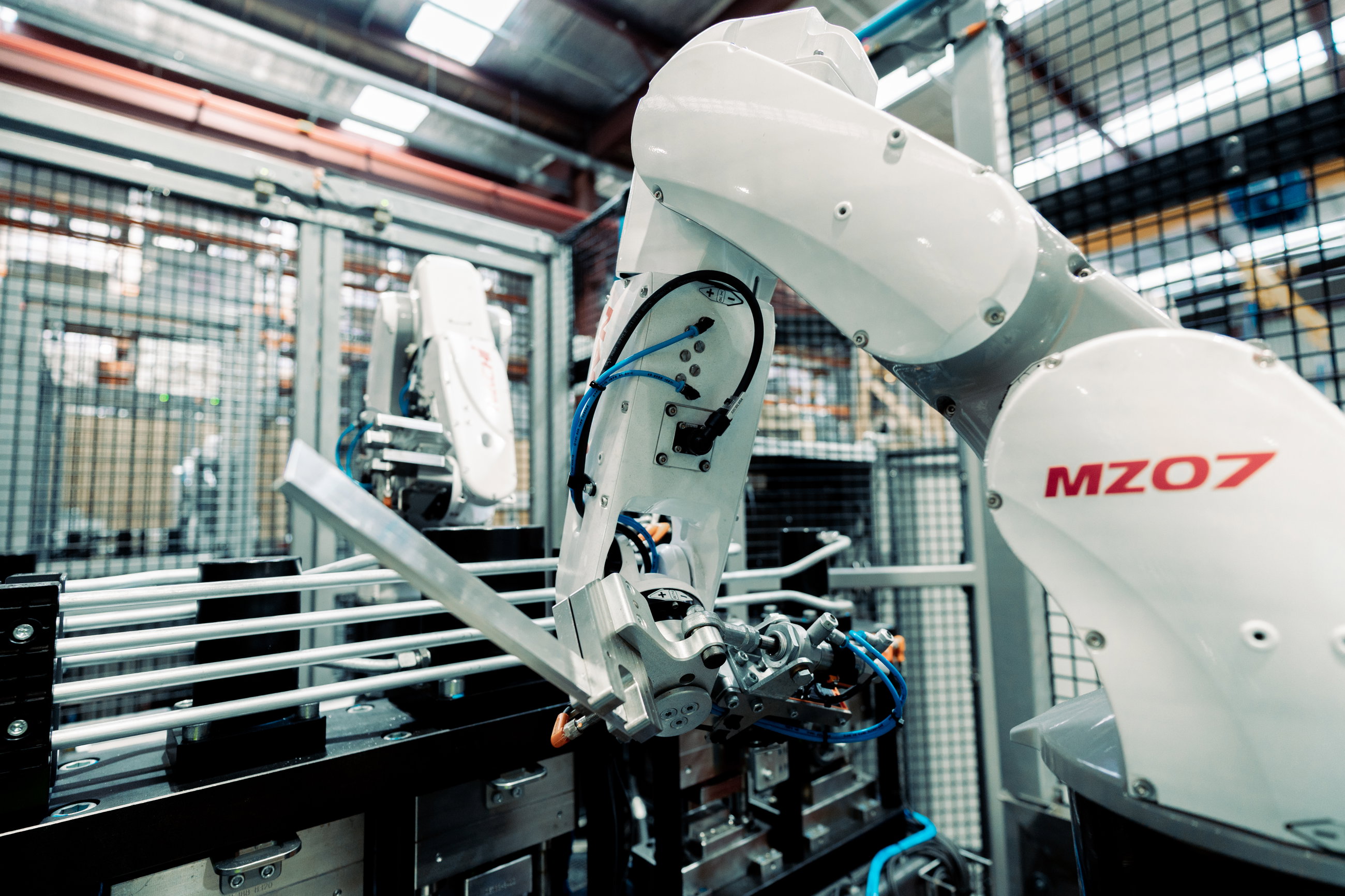
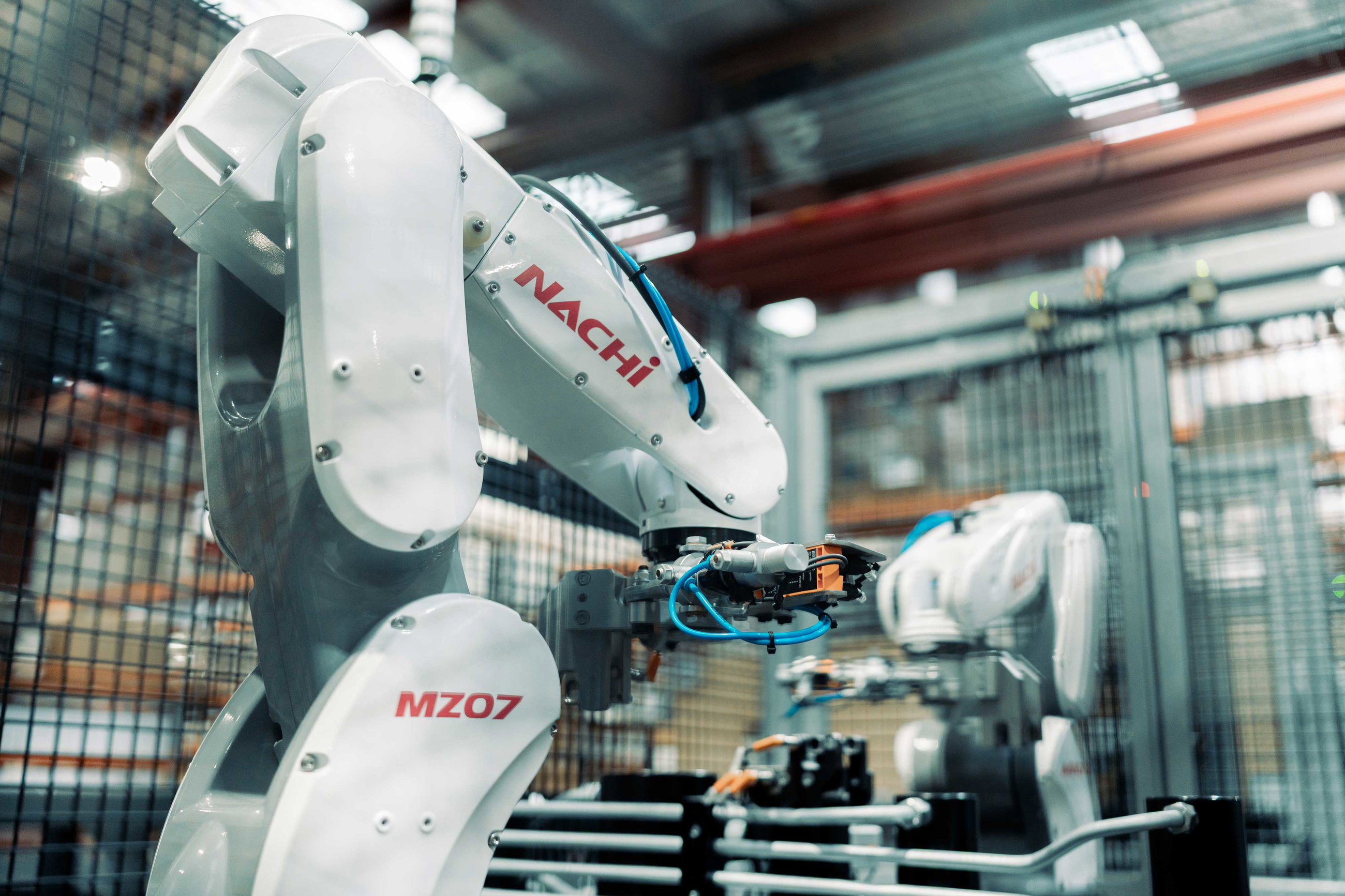
FMIBI Automation designed and built the system entirely in-house. Four Nachi MZ07 robots are arranged in two pairs. One pair produces the plates, the other produces the arms. Within each pair, the first robot makes one half of the component and hands the part to the second robot, which completes the other end.
The Nachi MZ07 was selected for two reasons: precision and speed. The stays must be made to tight tolerances, and the MZ07 is class-leading in positional accuracy for its size. It's also one of the fastest robots in its class, which was essential to hit the throughput targets.
Big capability, small footprint
The cell design is compact. The two robots in each pair share a central tooling station, with one robot feeding from each side. That kept the footprint small enough to fit the available floor space, which had no room to spare.
Changeovers between product variants are handled entirely in software. The operator selects the product required and the system adjusts automatically, with no manual tool changes or mechanical setup. That flexibility is something conventional press-based systems struggle to match, where switching between products often means hours of adjustment.
Designed for automation from the start
As part of the project, the FMIBI product team worked alongside the automation team to refine certain component features for automated production. Small design changes reduced tooling costs significantly, replacing expensive bespoke punch tools with more generic, lower-cost alternatives.
The outcome
Approximately twice the throughput of the previous manual process.
A job that previously required six skilled operators is now run by a single person tending both lines.
Precision and consistency no longer depend on operator skill, which means the line can run at night without requiring highly skilled labour on shift.
Fast, software-driven changeovers across the full product range with no mechanical setup.
Lower ongoing tooling costs through redesigned components suited to automated production.
A 100% bespoke system, designed and built in-house by FMIBI Automation.
"The Automation project has provided FMI with long‑term manufacturing capability, allowing us to produce precision parts with extreme levels of accuracy and repeatability. What would have taken six people now takes one. And because the skill element has been removed from the process, pretty much anyone can run the machine. We can run it in a light ‘s out operation, with the push of a button."
-Nico Pierik, Head of Accessories, FMIBI
To learn more about how we help manufacturers work smarter and faster with robotic automation, explore our automation capabilities.